Sunday, April 24, 2011
Wednesday, April 20, 2011
Thursday, July 29, 2010
Blogcomment record: "Julian Comstock" UPDATED
Paul Kinkaid reviewed Robert Charles Wilson's Julian Comstock.
Patrick Nielsen Hayden wondered if they read the same book. My comments:
I seem to have read the book pretty much the way DaveL@70 did, and the idea that Julian's homosexuality was "unnecessary" is boggling to me.
However, speaking of marked and unmarked states:
I am surprised that no-one has mentioned the unmarked elephant in this state room.
Am I the only reader who noticed [SPOILER! PROCEED WITH CAUTION! YOU MAY WANT TO FIGURE THIS OUT FOR YOURSELF DURING YOUR FIRST READING!]
that the narrator, his wife, and Julian's lover are all what we would call "black", but that it's apparently without "ethnic" significance? It is, IMHO, a very marked unmarkness, a joke Wilson is pulling on the readers, to put a lot of black characters (not just one, as in Left Hand of Darkness, but a *lot*) into a story and see if anyone notices.
The fact that Paul Kinkaid was reminded of the US Civil War but didn't see the black people strikes me as hilariously revealing, but in fact when I skimmed through a bunch of reviews *no-one* seems to have noticed -- even though this is set in a North America in which *slavery* has come back.
But then, I haven't come across anyone who's noticed that the ruling Church in Julian Comstock already exists, which is why Wilson put its headquarters in Colorado Springs. Or that the back-to-the-1880s political philosophy they use is actually taken directly from a certain trend in modern libertarians.
Chris Gerrib @ 77:
Actually, there are crumbs throughout the book indicating that the narrator and various other major characters are black. In particular, Wilson uses "tightly-curled" to describe what we'd call "black" hair. He's careful not to say "nappy", because he doesn't want the signal to be overt, he's *inclueing* the characters' race.
It's also not terribly relevant.
... um. You realize, don't you, that this parallels what Kincaid says about Julian's homosexuality. Indeed, I think one of the functions of homosexuality in the novel is to be the text while race is the subtext -- flipping the foreground/background in actual 19thC novels, where race could be text but sexuality had to be subtext.
No one else has spoken up, so I don't know if anyone here besides me perceived what Wilson does with race. I can't figure out which prospect boggles me more: that his clues were too subtle even for this group of very insightful readers, or that insightful readers noticed and thought it was trivial.
PNH @ 108:
Actually, it's more explicit than that: as Jeff Sharlet pointed out years ago, many important fundamentalist (and Dominionist) organizations have concentrated in Colorado Springs *precisely* in the hope that they can infiltrate/evangelize the Air Force. Focus on the Family is there, as is the New Life megachurch. In many ways, Colorado Springs already *is* the headquarters of Dominionism.
And yes, that's New Life Church as in "Ted Haggard", and that's why Julian Comstock's homosexuality is *crucial* to the story IMHO. Besides the Classic allusion, it's part of how Wilson shows that the tragedy of his future world is built from currently available ingredients.
OK, through the magic of Amazon.com, here are the descriptions:
Calyxa:
Like all good humorous novelists, I think the author spent some time laughing at *us*, the readers.
Jo Walton@179:
I'm very glad to hear that you noticed, because I remember looking up your review after I'd finally gotten around to reading the book, and was both boggled and distressed that you seemed to have missed the way Wilson marks (or rather un-marks) race. I'm relieved to know that I can still trust your powers of observation, but distressed that you didn't feel you could talk about what you observed in a way that wouldn't be misconstrued.
The fact that issues of gender, race, inclusion, and all that are under *constant* discussion on livejournal/dreamwidth made it easy for me to notice what Wilson does, but it also made it easy for me to think and talk about it.
I was hoping that someone in this discussion would know if Wilson has talked/written about the way he handles race in "Julian Comstock". I basically agree with Terry @242: I think the idea that slavery could come back to North America and *not* have anything to do with race is preposterous. But writers are allowed one preposterous assumption per book, and I'm willing to go along with this one.
Marilee @255:
I completely disagree. I think Wilson is describing this kind of hairstyle, not sausage curls.
Remember, Calyxa's hair is like a *halo* -- that certainly sounds like a 'fro. And black african hair definitely coils naturally -- each hair is like a little slinky.
In general, too, sausage curls are a highly artificial, high-maintenance hairstyle, and it seems clear to me that, throughout, the narrator is talking about Calyxa's natural hair, which her daughter inherits.
But I'm not sure if I would have come to the same conclusion about Calyxa's appearence based on this passage, except that I was looking for other unmarked black people once I noticed what Wilson did with the narrator.
Patrick Nielsen Hayden wondered if they read the same book. My comments:
I seem to have read the book pretty much the way DaveL@70 did, and the idea that Julian's homosexuality was "unnecessary" is boggling to me.
However, speaking of marked and unmarked states:
I am surprised that no-one has mentioned the unmarked elephant in this state room.
Am I the only reader who noticed [SPOILER! PROCEED WITH CAUTION! YOU MAY WANT TO FIGURE THIS OUT FOR YOURSELF DURING YOUR FIRST READING!]
that the narrator, his wife, and Julian's lover are all what we would call "black", but that it's apparently without "ethnic" significance? It is, IMHO, a very marked unmarkness, a joke Wilson is pulling on the readers, to put a lot of black characters (not just one, as in Left Hand of Darkness, but a *lot*) into a story and see if anyone notices.
The fact that Paul Kinkaid was reminded of the US Civil War but didn't see the black people strikes me as hilariously revealing, but in fact when I skimmed through a bunch of reviews *no-one* seems to have noticed -- even though this is set in a North America in which *slavery* has come back.
But then, I haven't come across anyone who's noticed that the ruling Church in Julian Comstock already exists, which is why Wilson put its headquarters in Colorado Springs. Or that the back-to-the-1880s political philosophy they use is actually taken directly from a certain trend in modern libertarians.
Chris Gerrib @ 77:
Actually, there are crumbs throughout the book indicating that the narrator and various other major characters are black. In particular, Wilson uses "tightly-curled" to describe what we'd call "black" hair. He's careful not to say "nappy", because he doesn't want the signal to be overt, he's *inclueing* the characters' race.
It's also not terribly relevant.
... um. You realize, don't you, that this parallels what Kincaid says about Julian's homosexuality. Indeed, I think one of the functions of homosexuality in the novel is to be the text while race is the subtext -- flipping the foreground/background in actual 19thC novels, where race could be text but sexuality had to be subtext.
No one else has spoken up, so I don't know if anyone here besides me perceived what Wilson does with race. I can't figure out which prospect boggles me more: that his clues were too subtle even for this group of very insightful readers, or that insightful readers noticed and thought it was trivial.
PNH @ 108:
Actually, it's more explicit than that: as Jeff Sharlet pointed out years ago, many important fundamentalist (and Dominionist) organizations have concentrated in Colorado Springs *precisely* in the hope that they can infiltrate/evangelize the Air Force. Focus on the Family is there, as is the New Life megachurch. In many ways, Colorado Springs already *is* the headquarters of Dominionism.
And yes, that's New Life Church as in "Ted Haggard", and that's why Julian Comstock's homosexuality is *crucial* to the story IMHO. Besides the Classic allusion, it's part of how Wilson shows that the tragedy of his future world is built from currently available ingredients.
OK, through the magic of Amazon.com, here are the descriptions:
Calyxa:
a pink and radiant face, and large eyes whose color I could not at this distance discern, although I imagined them (correctly, as it turned out) to be a handsome chestnut-brown; and a crown of hair that coiled list a vast collation of ebony springs, the light behind her making a spectacular Halo of it.Now, I admit that "pink" is suggestive of what we'd call a white woman -- but it's not clear if he's talking about someone like Beyonce, either. The hair, IMHO, is the crucial element in Wilson's descriptions of "black" characters, and when I read this I thought, "she's got a 'fro!" Throughout the book, Calyxa's hair is described as "coiled" (if not "spring-loaded"), and in the Epilogue when their daughter Flaxie is described:
her hair is as glossy and dark and tightly coiled as her mother's was.Now, for Magnus Stepney, Julian's lover, the description is unmistakable:
lustrously dark skin and wiry hair.While searching for these citations, I also came across the first description of Lymon Pugh, who has an "unruly knot of black hair" under his cap, and I wonder whether he, too, is supposed to be black ... or not.
Like all good humorous novelists, I think the author spent some time laughing at *us*, the readers.
Jo Walton@179:
I'm very glad to hear that you noticed, because I remember looking up your review after I'd finally gotten around to reading the book, and was both boggled and distressed that you seemed to have missed the way Wilson marks (or rather un-marks) race. I'm relieved to know that I can still trust your powers of observation, but distressed that you didn't feel you could talk about what you observed in a way that wouldn't be misconstrued.
The fact that issues of gender, race, inclusion, and all that are under *constant* discussion on livejournal/dreamwidth made it easy for me to notice what Wilson does, but it also made it easy for me to think and talk about it.
I was hoping that someone in this discussion would know if Wilson has talked/written about the way he handles race in "Julian Comstock". I basically agree with Terry @242: I think the idea that slavery could come back to North America and *not* have anything to do with race is preposterous. But writers are allowed one preposterous assumption per book, and I'm willing to go along with this one.
Marilee @255:
I completely disagree. I think Wilson is describing this kind of hairstyle, not sausage curls.
Remember, Calyxa's hair is like a *halo* -- that certainly sounds like a 'fro. And black african hair definitely coils naturally -- each hair is like a little slinky.
In general, too, sausage curls are a highly artificial, high-maintenance hairstyle, and it seems clear to me that, throughout, the narrator is talking about Calyxa's natural hair, which her daughter inherits.
But I'm not sure if I would have come to the same conclusion about Calyxa's appearence based on this passage, except that I was looking for other unmarked black people once I noticed what Wilson did with the narrator.
Labels: # science fiction, blogcomment, books, hugo awards, makinglight, race, reader response
Thursday, May 07, 2009
Sonia Sotomayor was not an Affirmitative Action student
Glenn Greenwald has been doing a great job of holding Jeffrey Rosen and The National Review's feet to the fire, for Rosen's anonymously-sourced hit piece on Sonia Sotamayor, in which he said she is "not that smart", "[unable] to provide an intellectual counterweight to the conservatives", whose good qualities are mostly that she's Puerto Rican and from poverty -- a combination that has led pretty much every blog I've seen, left or right, to connect the dots and say that what Rosen meant is that she benefited from Affirmative Action at Princeton and Yale Law.
I want to stop the right-wing meme that Sotomayor must have been an Affirmative Action admit to Princeton, intellectually second-rate but bossy. This meme is a lie: Sotomayor got into Princeton despite a restrictive quota system, and left with the highest award Princeton gives to undergraduates.
I'm highlighting and expanding on a comment that got lost in the barrage after Glenzilla's first post about Rosen's article.
Commenter "PollyPerks" noted that, based on dates and statistics alone, Sonia Sotomayor *could not* have been a "mere Affirmative Action" admit to Princeton, because she entered during the early years of Princeton co-education, when women were subject to a restrictive quota system.
I am a female member of Princeton's Class of 1978, 2 years after Sotomayor, and I have personal memory and experience to back PollyPerks up. Like Polly, I am also relying on Jerome Karabel's The Chosen, which I highly recommend and which made many things clear to me in retrospect.
I have no clear memory of meeting Sotomayor, though I certainly knew of her -- she was extremely energetic and politically active, heading the Latino student group and other campus activities. She graduated summa cum laude, a very rare distinction at Princeton, not to be acquired without both a stellar senior thesis and across-the-board As in one's major: many departments would have no summas in any given year.
Sotomayor applied to Princeton in only the 3rd year of co-education. Princeton came to co-education late even for an Ivy, and the Board of Trustees had set strict limits on how exuberantly women could rush in. In particular, the original agreement between the University administration and the Board stipulated that the number of men admitted would never decrease -- no man would risk being out-competed by a woman for a seat at Princeton. Instead, the total number of students would have to increase: we women were explicitly competing for a separate pool of seats, a rather small one at first because there wasn't enough housing for us.
(And if housing was a problem, a female friend in the Class of 1975 reminds me that bathrooms were worse. It was only several years after I entered that it was no longer common to see a bathrobe-clad woman going out of one dorm and into the doorway next door, in search of a shower.)
As Polly said, quote Karabel: only 14 percent of the female applicants were accepted, compared to 22 percent of the men. ...[T]he women who were admitted to Princeton were even more elite both academically and socially than their male classmates".
This was obvious and much-discussed by the students ourselves. We could see that pretty much every woman admitted to Princeton was abnormally bright, ambitious, and hard-working, while the male population included a certain fraction of guys who were just there because going to Princeton was what the [Family Name]s *did*.
It was those men -- the Princeton equivalents of George W. Bush -- who were the beneficiaries of "affirmative action" at Princeton, not Sonia Sotomayor. PollyPerks quotes from Karabel:
In working on this post, I discovered that Sotomayor not only graduated summa cum laude (which is determined by the departments), she received the M. Taylor Pyne Prize for 1976.
The Pyne Prize is the highest award Princeton gives to an undergraduate (it goes to two people per year), and is supposed to reflect both scholarship and leadership.
It is flatly impossible for a Pyne Prize recipient to be "not that smart" or to "lack intellectual weight", as Rosen's "sources" said. There may be fashions or pressures in what specific person gets the award, but it's always to someone who looks *really* smart even when they're surrounded by very smart people. Frankly, I would have to be *insane* to not assume that Sotomayor is smarter than me -- I mean, one Pyne Prize winner for my year (1978) was Eric Lander, and he's pretty much smarter than anyone.
Now, I will admit that based on my mostly-paper-but-slightly-inside knowledge, Elena Kagan (Princeton Class of 1981) is probably in Sotomayor's league. Kagan also was summa cum laude, and received a very prestigious scholarship to study at Oxford after Princeton. From the Princeton point of view, it's all good. But also from the Princeton POV, both Sotomayor and Kagan look much more impressive than Samuel Alito (Class of 1972), who did well there but not blow-your-socks-off well.
In contrast, on paper, based solely on their academic records, Scalia and Roberts really are (or should be) at the top of the league. But then, that should also be the case for Stevens, Ginsburg, Breyer, and Souter. I don't know whether there's actually much correlation between undergraduate record and performance on SCOTUS. Remember, it's the absolute pinnacle of the profession, but it's also *a committee*, which means issues of personality, temperament, and social cunning can be at least as important as pure intellect.
What Karabel's book illuminated for me was how much of a dance Princeton and its ilk were negotiating in the 60s and 70s. Princeton et al. did not become co-ed and more diverse out of pure goodness of heart. A certain amount of idealism was definitely involved -- people at the colleges thought it was *right* that their educations, and by extension membership in America's ruling class, should be available to a wider range of candidates.
But they also knew that change was coming, and it was important for the new faces in the American power structure have some of the old labels: "Bottled at Princeton" or "Bottled at Harvard". The strength of the Expensive Higher Education brand, as it were, depended both on helping those who *should* succeed, and making sure that those who *would* succeed regardless (because of their inherited money and family) still passed through their gates.
Back when Alito was joining Concerned Alumni of Princeton to protest the University letting in a bunch of riff-raff, IIRC (from Karabel) Shelby Collum Davis argued that there was no point in wasting some of Princeton's future-leaders spots on women, because it was preposterous to think women were going to be future leaders. Similar arguments could have been (and probably were) made for black students, Latinas, Asians, and so forth.
As an aside, I assume Alito, who got into Princeton out of pure ability (poor, local, Catholic, Italian) and was always a bit outside the WASP social structure, wanted to make sure that the club door was slammed behind him, to maintain the cachet of the brand he had worked so hard to achieve.
Now, at last, we can really start to see how well the Expensive Higher Ed admissions staff from the 60s and 70s did their job. Their job was to make sure that when Americans, decades later, went looking for possible Supreme Court justices or even Presidents who weren't white men, the obvious candidates bore the Expensive Higher Ed brand names. Sotomayor, Kagan, and both Obamas represent not only great advances for American inclusiveness, but great successes for the Ivy League system and its role, good and bad, in the American power structure.
Updated to correct some errors and obscurities.
Also: I haven't seen a blog yet, left or right, where either the poster or the comments doesn't say something about Sotomayor being an affirmative action beneficiary. I can't believe it's coincidence that the one of her cases that has attracted most attention was about affirmative action. Glenn Greenwald's update this morning has plenty of links to how this is being played out.
And to those still wondering "but why does it have to be a *woman*? What about the best person for the job?" -- The display the male justices put on during the recent oral arguments about the strip-search case made it brutally clear that the current gender balance on SCOTUS is intolerable.
I want to stop the right-wing meme that Sotomayor must have been an Affirmative Action admit to Princeton, intellectually second-rate but bossy. This meme is a lie: Sotomayor got into Princeton despite a restrictive quota system, and left with the highest award Princeton gives to undergraduates.
I'm highlighting and expanding on a comment that got lost in the barrage after Glenzilla's first post about Rosen's article.
Commenter "PollyPerks" noted that, based on dates and statistics alone, Sonia Sotomayor *could not* have been a "mere Affirmative Action" admit to Princeton, because she entered during the early years of Princeton co-education, when women were subject to a restrictive quota system.
I am a female member of Princeton's Class of 1978, 2 years after Sotomayor, and I have personal memory and experience to back PollyPerks up. Like Polly, I am also relying on Jerome Karabel's The Chosen, which I highly recommend and which made many things clear to me in retrospect.
I have no clear memory of meeting Sotomayor, though I certainly knew of her -- she was extremely energetic and politically active, heading the Latino student group and other campus activities. She graduated summa cum laude, a very rare distinction at Princeton, not to be acquired without both a stellar senior thesis and across-the-board As in one's major: many departments would have no summas in any given year.
Sotomayor applied to Princeton in only the 3rd year of co-education. Princeton came to co-education late even for an Ivy, and the Board of Trustees had set strict limits on how exuberantly women could rush in. In particular, the original agreement between the University administration and the Board stipulated that the number of men admitted would never decrease -- no man would risk being out-competed by a woman for a seat at Princeton. Instead, the total number of students would have to increase: we women were explicitly competing for a separate pool of seats, a rather small one at first because there wasn't enough housing for us.
(And if housing was a problem, a female friend in the Class of 1975 reminds me that bathrooms were worse. It was only several years after I entered that it was no longer common to see a bathrobe-clad woman going out of one dorm and into the doorway next door, in search of a shower.)
As Polly said, quote Karabel: only 14 percent of the female applicants were accepted, compared to 22 percent of the men. ...[T]he women who were admitted to Princeton were even more elite both academically and socially than their male classmates".
This was obvious and much-discussed by the students ourselves. We could see that pretty much every woman admitted to Princeton was abnormally bright, ambitious, and hard-working, while the male population included a certain fraction of guys who were just there because going to Princeton was what the [Family Name]s *did*.
It was those men -- the Princeton equivalents of George W. Bush -- who were the beneficiaries of "affirmative action" at Princeton, not Sonia Sotomayor. PollyPerks quotes from Karabel:
"1968-1969 was also the year Princeton began to recruit Mexican Americans, Puerto Ricans, and Native Americans and expanded its efforts to recruit more 'disadvantaged' whites" (p. 398).
In 1972, Princeton reported that the freshman class included 22 Latino students, 15 Chicano students, 27 "Oriental" students, 5 Indian students, and 113 black students, for a total of 181 "Third World students" (as Princeton then called them) out of a class of approximately 1127 (p. 399).
To compare, the number of students admitted as athletes was 310 (p. 477) and many spaces (approximately 200-250) were taken by legacies, who were admitted with significantly lower qualifications (p. 467, 478):
"Princeton ... was careful not to tamper with legacy preference. Admissions rate for alumni children never fell much below double the rate for other applicants, and in the mid-1970s preferences for legacies actually increased. In 1975, 48 percent gained admission - a rate 2.3 times higher than other applicants." (p. 478)
In working on this post, I discovered that Sotomayor not only graduated summa cum laude (which is determined by the departments), she received the M. Taylor Pyne Prize for 1976.
The Pyne Prize is the highest award Princeton gives to an undergraduate (it goes to two people per year), and is supposed to reflect both scholarship and leadership.
It is flatly impossible for a Pyne Prize recipient to be "not that smart" or to "lack intellectual weight", as Rosen's "sources" said. There may be fashions or pressures in what specific person gets the award, but it's always to someone who looks *really* smart even when they're surrounded by very smart people. Frankly, I would have to be *insane* to not assume that Sotomayor is smarter than me -- I mean, one Pyne Prize winner for my year (1978) was Eric Lander, and he's pretty much smarter than anyone.
Now, I will admit that based on my mostly-paper-but-slightly-inside knowledge, Elena Kagan (Princeton Class of 1981) is probably in Sotomayor's league. Kagan also was summa cum laude, and received a very prestigious scholarship to study at Oxford after Princeton. From the Princeton point of view, it's all good. But also from the Princeton POV, both Sotomayor and Kagan look much more impressive than Samuel Alito (Class of 1972), who did well there but not blow-your-socks-off well.
In contrast, on paper, based solely on their academic records, Scalia and Roberts really are (or should be) at the top of the league. But then, that should also be the case for Stevens, Ginsburg, Breyer, and Souter. I don't know whether there's actually much correlation between undergraduate record and performance on SCOTUS. Remember, it's the absolute pinnacle of the profession, but it's also *a committee*, which means issues of personality, temperament, and social cunning can be at least as important as pure intellect.
What Karabel's book illuminated for me was how much of a dance Princeton and its ilk were negotiating in the 60s and 70s. Princeton et al. did not become co-ed and more diverse out of pure goodness of heart. A certain amount of idealism was definitely involved -- people at the colleges thought it was *right* that their educations, and by extension membership in America's ruling class, should be available to a wider range of candidates.
But they also knew that change was coming, and it was important for the new faces in the American power structure have some of the old labels: "Bottled at Princeton" or "Bottled at Harvard". The strength of the Expensive Higher Education brand, as it were, depended both on helping those who *should* succeed, and making sure that those who *would* succeed regardless (because of their inherited money and family) still passed through their gates.
Back when Alito was joining Concerned Alumni of Princeton to protest the University letting in a bunch of riff-raff, IIRC (from Karabel) Shelby Collum Davis argued that there was no point in wasting some of Princeton's future-leaders spots on women, because it was preposterous to think women were going to be future leaders. Similar arguments could have been (and probably were) made for black students, Latinas, Asians, and so forth.
As an aside, I assume Alito, who got into Princeton out of pure ability (poor, local, Catholic, Italian) and was always a bit outside the WASP social structure, wanted to make sure that the club door was slammed behind him, to maintain the cachet of the brand he had worked so hard to achieve.
Now, at last, we can really start to see how well the Expensive Higher Ed admissions staff from the 60s and 70s did their job. Their job was to make sure that when Americans, decades later, went looking for possible Supreme Court justices or even Presidents who weren't white men, the obvious candidates bore the Expensive Higher Ed brand names. Sotomayor, Kagan, and both Obamas represent not only great advances for American inclusiveness, but great successes for the Ivy League system and its role, good and bad, in the American power structure.
Updated to correct some errors and obscurities.
Also: I haven't seen a blog yet, left or right, where either the poster or the comments doesn't say something about Sotomayor being an affirmative action beneficiary. I can't believe it's coincidence that the one of her cases that has attracted most attention was about affirmative action. Glenn Greenwald's update this morning has plenty of links to how this is being played out.
And to those still wondering "but why does it have to be a *woman*? What about the best person for the job?" -- The display the male justices put on during the recent oral arguments about the strip-search case made it brutally clear that the current gender balance on SCOTUS is intolerable.
Labels: blogcomment, books, education, glenngreenwald, legal system, princeton, supreme court
Tuesday, November 25, 2008
Books to understand America
ari at Edge of the American West put up his list of history books that would allow an interested but non-expert reader to "understand America". My comments:
Albion’s Seed is a book I’ve given as a present several times, always to great effect. I absolutely think it belongs on the list, because its social history gives the context — the bones, as it were — for the political history on the rest of the list. For me, American Slavery, American Freedom can be subsumed into Albion’s Seed — that is, ASAP fleshes out a subset of the ideas in AS.
And for giving real context to your context, I think you also need to include 1491.
And if you’re looking for a book to open the door to discuss issues about women, the frontier, land use, industrialization, and education (to name a few), there is no source better IMHO than Laura Ingalls Wilder. If you have to pick just one volume, it should probably be either Little House on the Prairie or The Long Winter.
I am not kidding.
teofilo, the mandate is “10 books to help an interested but non-expert reader to *understand America*.” I think for that purpose I would drop the Gordon Wood, which is, as ari said, over-focused. I don’t know if there’s a Revolution-through-Constitution equivalent of McPherson.
If we’re including fiction — which I certainly would — I don’t see how Moby Dick gives an enormous amount of “understanding America”; Huck Finn is the lynchpin. I’m racking my brains, but I can’t think of a fiction about 20th-century America that is as pivotal and illuminating. The defining works of 20th-century culture are on film, IMHO.
SEK:
The reason I favor Huck Finn as opposed to Moby Dick for this purpose is that both landscape and characters are so varied yet characteristically American, and the ending of the book, though IMHO a literary failure, is a failure of an extremely American type. I think MD is a better *novel*, but HF is more helpful in understanding what we are and where we come from, what kind of people America has tended to grow up and what kind of stories we tell ourselves about who we are.
Also, SEK, in what way does Moby Dick contain a “larger sociological cast” than Huck Finn? The thing that jumps out at me is that Moby Dick contains neither women nor children: it is 100% guy with no non-guy elements, so calling it sociologically large strikes me as, well, wrong.
Not that there probably isn’t a paper to be written on “Huck/Jim and/or Ishmael/Queequeg: the Interracial Bromance of American Literature”, if Eve Sedgwick didn’t write it already.
Albion’s Seed is a book I’ve given as a present several times, always to great effect. I absolutely think it belongs on the list, because its social history gives the context — the bones, as it were — for the political history on the rest of the list. For me, American Slavery, American Freedom can be subsumed into Albion’s Seed — that is, ASAP fleshes out a subset of the ideas in AS.
And for giving real context to your context, I think you also need to include 1491.
And if you’re looking for a book to open the door to discuss issues about women, the frontier, land use, industrialization, and education (to name a few), there is no source better IMHO than Laura Ingalls Wilder. If you have to pick just one volume, it should probably be either Little House on the Prairie or The Long Winter.
I am not kidding.
teofilo, the mandate is “10 books to help an interested but non-expert reader to *understand America*.” I think for that purpose I would drop the Gordon Wood, which is, as ari said, over-focused. I don’t know if there’s a Revolution-through-Constitution equivalent of McPherson.
If we’re including fiction — which I certainly would — I don’t see how Moby Dick gives an enormous amount of “understanding America”; Huck Finn is the lynchpin. I’m racking my brains, but I can’t think of a fiction about 20th-century America that is as pivotal and illuminating. The defining works of 20th-century culture are on film, IMHO.
SEK:
The reason I favor Huck Finn as opposed to Moby Dick for this purpose is that both landscape and characters are so varied yet characteristically American, and the ending of the book, though IMHO a literary failure, is a failure of an extremely American type. I think MD is a better *novel*, but HF is more helpful in understanding what we are and where we come from, what kind of people America has tended to grow up and what kind of stories we tell ourselves about who we are.
Also, SEK, in what way does Moby Dick contain a “larger sociological cast” than Huck Finn? The thing that jumps out at me is that Moby Dick contains neither women nor children: it is 100% guy with no non-guy elements, so calling it sociologically large strikes me as, well, wrong.
Not that there probably isn’t a paper to be written on “Huck/Jim and/or Ishmael/Queequeg: the Interracial Bromance of American Literature”, if Eve Sedgwick didn’t write it already.
Labels: blogcomment, books, edge of the american west, history
Sunday, April 27, 2008
YA book recs wanted: Rashomon
At dinner we were discussing how to write a story with a cast of thousands, and also how to write a book that covers a brief time period. One of the techniques we talked about was the "Rashomon" method, where the story is re-told from different viewpoints, and each time you get a completely different idea about what happened and what the people are like.
The Distant Future of Fandom (age 12) thought this was a great idea, and asked for recommendations for suitable books written this way. We couldn't think of any, so I ask you for recs. Her reading level is near-adult, but she doesn't want anything with sex or violence (including most horror), and nothing where the story revolves around romance ("bo-ring").
In talking about cast-of-thousands stories we talked about The Odyssey, which the DFoF is currently reading as her "outside the curriculum" book for English class. And we also talked about books with very compressed time-frames, and how that's easiest if it's the end of the world (or other sweaping traumatic event). But, she said, you *could* have a book about only one ordinary day if it were done in enough detail. Especially if it's a thought-diary, where you put in everything the person thinks.
Yes, that's right. Our 12-year-old deduced the existence of Joyce's "Ulysses". I don't know whether to be more smug or more staggered.
While I'm at it, I'll record my comment from the Dreamcafe post:
The reason they’re telling you not to do cast-of-thousands stories is that *most* of them suck like a hoover — see most disaster novels, the kind that have a cast list and that flip from one set of characters to the next in a set rotation.
Any time you need a cast list, you’re probably doin’ it wrong, because that means there are too many characters for the reader to keep track of who’s who. The reader can only keep track of actual characters at some rate — characters introduced per 5000 words is probably the metric to use — which is not infinite. It also depends on the rate at which the reader (viewer) will consume what you’re writing. Tolstoy & Dickens had a lot of “readers” who were actually getting the works as read-alouds, which is much slower and gives the readers a lot more time to absorb each character before going on to the next.
Steven (and Terry Pratchett) have built up enormous casts by the more modern method of writing series, where each book is a mix of older characters and new ones. I think adding new characters in spurts like that is particularly effective, because they come as “sets” which are easier to remember.
It’s like, imagine you’re at a con (or conference) where you have to meet 50 people in two days, then go home and write up your impressions of each one. You can talk to each person for an hour, never sleep, and if you’re me when you get home it will be all a blur. And you’ll have Con Crud.
Or you can meet them as panels of 5, two hours per panel, still have time for sleep and personal hygiene, and when you come home each person will have a context and a prayer that you’ll remember them.
You’ll still probably have Con Crud, though.
The Distant Future of Fandom (age 12) thought this was a great idea, and asked for recommendations for suitable books written this way. We couldn't think of any, so I ask you for recs. Her reading level is near-adult, but she doesn't want anything with sex or violence (including most horror), and nothing where the story revolves around romance ("bo-ring").
In talking about cast-of-thousands stories we talked about The Odyssey, which the DFoF is currently reading as her "outside the curriculum" book for English class. And we also talked about books with very compressed time-frames, and how that's easiest if it's the end of the world (or other sweaping traumatic event). But, she said, you *could* have a book about only one ordinary day if it were done in enough detail. Especially if it's a thought-diary, where you put in everything the person thinks.
Yes, that's right. Our 12-year-old deduced the existence of Joyce's "Ulysses". I don't know whether to be more smug or more staggered.
While I'm at it, I'll record my comment from the Dreamcafe post:
The reason they’re telling you not to do cast-of-thousands stories is that *most* of them suck like a hoover — see most disaster novels, the kind that have a cast list and that flip from one set of characters to the next in a set rotation.
Any time you need a cast list, you’re probably doin’ it wrong, because that means there are too many characters for the reader to keep track of who’s who. The reader can only keep track of actual characters at some rate — characters introduced per 5000 words is probably the metric to use — which is not infinite. It also depends on the rate at which the reader (viewer) will consume what you’re writing. Tolstoy & Dickens had a lot of “readers” who were actually getting the works as read-alouds, which is much slower and gives the readers a lot more time to absorb each character before going on to the next.
Steven (and Terry Pratchett) have built up enormous casts by the more modern method of writing series, where each book is a mix of older characters and new ones. I think adding new characters in spurts like that is particularly effective, because they come as “sets” which are easier to remember.
It’s like, imagine you’re at a con (or conference) where you have to meet 50 people in two days, then go home and write up your impressions of each one. You can talk to each person for an hour, never sleep, and if you’re me when you get home it will be all a blur. And you’ll have Con Crud.
Or you can meet them as panels of 5, two hours per panel, still have time for sleep and personal hygiene, and when you come home each person will have a context and a prayer that you’ll remember them.
You’ll still probably have Con Crud, though.
Labels: blogcomment, books, dreamcafe, YA
Sunday, March 30, 2008
Reproductive Justice
Amanda at Pandagon reported about the Reproductive Justice panel at the Women, Action and the Media Conference at MIT. I said:
I just finished reading E.J. Dionne’s Souled Out. Dionne is a liberal Catholic of a sort that is very familiar to me, many of whom are/were heavily involved in the social justice movement. He doesn’t talk about “reproductive justice” by name, but he does talk favorably about the basic approach.
To what extent do you think Catholics can or will become part of a reproductive justice movement? Do we have to try to make people *consciously* aware of how their anti-abortion platform is
I just finished reading E.J. Dionne’s Souled Out. Dionne is a liberal Catholic of a sort that is very familiar to me, many of whom are/were heavily involved in the social justice movement. He doesn’t talk about “reproductive justice” by name, but he does talk favorably about the basic approach.
To what extent do you think Catholics can or will become part of a reproductive justice movement? Do we have to try to make people *consciously* aware of how their anti-abortion platform is
a stand-in for a series of anxieties about sexuality and ego(which is IMHO certainly true), or is it possible to move them without forcing those issues into consciousness? Can we get them to agree consciously to the importance of empowering women *even though* that is the the thing they’re unconsciously afraid of?
Labels: abortion, blogcomment, books, pandagon, politics, religion
Monday, December 10, 2007
Book report: The Invisible Sex, by Adovasio, Soffer, Page
The Invisible Sex: Uncovering the True Roles of Women in Prehistory by J. M. Adovasio, Olga Soffer, Jake Page
I wanted to like this book more than I did. I wanted it to be the Compleat Feminist Smackdown of Stupid Patriarchal Paleoanthropology; instead, it's some good smackdown ingredients plus some other stuff.
The authors (who I will abbreviate as A/S/P) do a great job of showing how important it is to get women working in paleoanthropology. Soffer herself is a good example: she may have been the first paleoarcheologist to study the clothing and hairstyles of Venus figurines, instead of getting stuck on "OMGbreasts!"
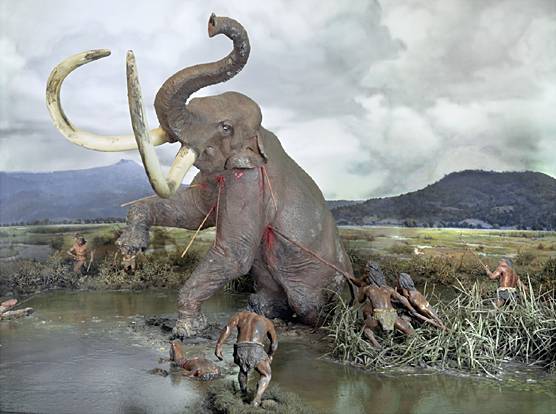
A/S/P do a great job of deconstructing many of the canonical stories about The Ascent of Man as male-centered fantasies. For instance, all the pictures of Stone Age hunters fighting mammoth or other large mammals (this latter from the classic Og, Son of Fire). These images show hunting as crucial, men-only, and risky -- but as A/S/P point out, this is based on neither good archaeology nor good anthropology. Modern hunter-gatherers don't habitually hunt large, fierce animals, it's not worth it the risk that someone will be injured or killed. The paleo-archeological evidence is much more compatible with "Mammoth Hunters" being Mammoth Scavengers, who only killed the animals when they were halfway dead already.
Disappointingly, A/S/P turn around and make up stories of their own. Chapter 6, "Leaving the African Cradle", ends with fictional accounts of the lives of various "mitochondrial mothers", which I found basically unreadable for their lack of a scientific basis.
This book really made me appreciate how many extremely inter-disciplinary paleoanthropology is, and how easy it is for specialists to run into trouble. A/S/P know a great deal about Late Stone Age technology, especially in materials other than stone: the perishable fiber, skin, and bone materials that undoubtably were most of the "stuff" in ancient people's lives. Since Elizabeth Wayland Barber's Women's Work: The First 20,000 Years : Women, Cloth, and Society in Early Times is one of my and their favorite books, I'm already on board with their program to actually look for evidence of perishable "stuff" and women's work. They're really good about bringing in an anthropologist's sense of the complexity of tool making, use, and ownership in traditional societies. People in the culture may tell the anthropologist that a particular task is "women's work" or a particular material is "for men", but in practice the two genders depend on each other continuously. Hypothetical example, though not unlike many North American Indian cultures:
So saying "men make sandals and women make shirts" is an oversimplification: it takes work by both genders to make each type of object, and no-one gets a complete outfit without cross-gender cooperation.
Though the book doesn't discuss this, I'll point out here that this, IMHO, is what human marriage is originally "for": the exchange of specialized labor between adults. Sex and children are side effects, the real purpose of marriage is to permit individuals to specialize in either "men's work" or "women's work" but be able to take advantage of both.
Back to the book. Although A/S/P are great at anthropology, they really don't know all that much biology. I feel as though they're really struggling with the fact that no organ comes "for free", that even eyes or intestines will fall away over evolutionary time if they're not useful. Not to mention that calling Alison Jolly "a primatologist who taught at Princeton" gave me a real WTF moment and shows they really aren't familiar with non-human primates and the people who study them (Jolly is the Jane Goodall of Madagascar, the first person to do real field observations of lemur behavior).
Bacause of their weakness in biology, A/S/P don't always know how much evidence they can use to eviscerate the Man-the-Hunter -Drove-Human-Evolution myth. For instance, they talk a lot about hunting animals versus gathering plant food (who did which, which was a more important source of nutrients, etc), but don't seem to realize that carnivorous animals aren't necessarily all that intelligent. In the human hunting:gathering equation, gathering -- using a wide variety of plants for food -- requires more brain-power than hunting. In the story of Christopher McCandless John Krakauer told in Into the Wild, for instance, what killed McCandless was what he didn't know about plant food; he had no particular trouble hunting more meat than he could eat.
It may also be their insecurity with the more biologically-based parts of the field that keep A/S/P from pushing the implications of their work back before the Upper Paleolithic. Evidence from human louse genes supports the idea that clothing and the strings that hold it together dates to about 70,000 years ago, though further louse research indicates that our ancestors lost their body hair much, much earlier, at the start of genus Homo if not before.
My dissatisfactions with the book in fact support A/S/P's thesis: that human evolution is such a complex and emotionally-loaded topic that we can't afford to exclude points of view. It's like trying to study a complicated structure you're living inside: you need to cross-correlate as many POVs as possible to get an idea of the big picture.
I wanted to like this book more than I did. I wanted it to be the Compleat Feminist Smackdown of Stupid Patriarchal Paleoanthropology; instead, it's some good smackdown ingredients plus some other stuff.
The authors (who I will abbreviate as A/S/P) do a great job of showing how important it is to get women working in paleoanthropology. Soffer herself is a good example: she may have been the first paleoarcheologist to study the clothing and hairstyles of Venus figurines, instead of getting stuck on "OMGbreasts!"
A/S/P do a great job of deconstructing many of the canonical stories about The Ascent of Man as male-centered fantasies. For instance, all the pictures of Stone Age hunters fighting mammoth or other large mammals (this latter from the classic Og, Son of Fire). These images show hunting as crucial, men-only, and risky -- but as A/S/P point out, this is based on neither good archaeology nor good anthropology. Modern hunter-gatherers don't habitually hunt large, fierce animals, it's not worth it the risk that someone will be injured or killed. The paleo-archeological evidence is much more compatible with "Mammoth Hunters" being Mammoth Scavengers, who only killed the animals when they were halfway dead already.
Disappointingly, A/S/P turn around and make up stories of their own. Chapter 6, "Leaving the African Cradle", ends with fictional accounts of the lives of various "mitochondrial mothers", which I found basically unreadable for their lack of a scientific basis.
This book really made me appreciate how many extremely inter-disciplinary paleoanthropology is, and how easy it is for specialists to run into trouble. A/S/P know a great deal about Late Stone Age technology, especially in materials other than stone: the perishable fiber, skin, and bone materials that undoubtably were most of the "stuff" in ancient people's lives. Since Elizabeth Wayland Barber's Women's Work: The First 20,000 Years : Women, Cloth, and Society in Early Times is one of my and their favorite books, I'm already on board with their program to actually look for evidence of perishable "stuff" and women's work. They're really good about bringing in an anthropologist's sense of the complexity of tool making, use, and ownership in traditional societies. People in the culture may tell the anthropologist that a particular task is "women's work" or a particular material is "for men", but in practice the two genders depend on each other continuously. Hypothetical example, though not unlike many North American Indian cultures:
Men's Work Women's Work hunt deer skin deer remove hair & meat soften (tan) hide cut hide into pieces twist leather into sandals sew leather into shirts
So saying "men make sandals and women make shirts" is an oversimplification: it takes work by both genders to make each type of object, and no-one gets a complete outfit without cross-gender cooperation.
Though the book doesn't discuss this, I'll point out here that this, IMHO, is what human marriage is originally "for": the exchange of specialized labor between adults. Sex and children are side effects, the real purpose of marriage is to permit individuals to specialize in either "men's work" or "women's work" but be able to take advantage of both.
Back to the book. Although A/S/P are great at anthropology, they really don't know all that much biology. I feel as though they're really struggling with the fact that no organ comes "for free", that even eyes or intestines will fall away over evolutionary time if they're not useful. Not to mention that calling Alison Jolly "a primatologist who taught at Princeton" gave me a real WTF moment and shows they really aren't familiar with non-human primates and the people who study them (Jolly is the Jane Goodall of Madagascar, the first person to do real field observations of lemur behavior).
Bacause of their weakness in biology, A/S/P don't always know how much evidence they can use to eviscerate the Man-the-Hunter -Drove-Human-Evolution myth. For instance, they talk a lot about hunting animals versus gathering plant food (who did which, which was a more important source of nutrients, etc), but don't seem to realize that carnivorous animals aren't necessarily all that intelligent. In the human hunting:gathering equation, gathering -- using a wide variety of plants for food -- requires more brain-power than hunting. In the story of Christopher McCandless John Krakauer told in Into the Wild, for instance, what killed McCandless was what he didn't know about plant food; he had no particular trouble hunting more meat than he could eat.
It may also be their insecurity with the more biologically-based parts of the field that keep A/S/P from pushing the implications of their work back before the Upper Paleolithic. Evidence from human louse genes supports the idea that clothing and the strings that hold it together dates to about 70,000 years ago, though further louse research indicates that our ancestors lost their body hair much, much earlier, at the start of genus Homo if not before.
My dissatisfactions with the book in fact support A/S/P's thesis: that human evolution is such a complex and emotionally-loaded topic that we can't afford to exclude points of view. It's like trying to study a complicated structure you're living inside: you need to cross-correlate as many POVs as possible to get an idea of the big picture.
Saturday, December 08, 2007
Book report: Baboon Metaphysics, by Cheney & Seyfarth
Book review at last! (or else InterLibrary Loan will come after me with *knives*):
Baboon Metaphysics: The Evolution of a Social Mind, by Dorothy L. Cheney & Robert M. Seyfarth.
Cheney/Seyfarth and their colleagues have done exemplary work developing behavioral experiments in the field, the Okavango Delta. They have done beautiful work using recorded calls & playback experiments, and they've resisted all temptation to interfere with the baboons' lives, even during lion attacks.
The book comes with my highest recommendation -- the Amazon Reader Reviews give a very good flavor for what's in it, overall. This is a list of things *I* learned, even if there's a lot more in it that may be new to you.
1. Baboons recognize kinship. I don't mean they just recognize their own kin - that's not surprising, has been documented in all kinds of critters. I mean they recognize *other creatures' kin relationships*. Most vivid story is about Ahla, a baboon that was kept as a goat-herder by a farmer. She made great efforts to unite mother goats with their proper lambs, to the point where it caused problems when the farmer tried the standard method of fostering one of a pair of twin lambs with another mother. Ahla had none of this: she knew which lambs went with which mothers, and that's how she was going to make it be.
2. Baboon societies are made up of matrilines, groups of female blood relatives. The matrilines have a dominance hierarchy which overrides individual dominance -- the matriline rises or falls *together*. Such alterations are rare, the female hierarchy tends to be stable for years running.
3. It's not clear that baboons think of kin relationships in terms of "mother", "child", but they definitely think that certain individuals "go together", and the "going together" is a lot like property relationships.
4. When a female fights with a female from another matriline, they more often make up by proxy than directly. That is, a relative from the other matriline makes reconciling gestures (e.g. grooming), they calm down, and that acts to reconcile the fighters -- even if they haven't made reconciling gestures to each other.
5. The male hierarchy is simple and volatile. Males have few long-term relationships, and C/S think this is one reason males have much shorter lifespans than females: strong social relationships are buffers against emotional stress, especially fear and grief.
6. In their study population, the leading cause of death for infants is infanticide by males. Adults mostly die from predation. The habitat is extremely rich and the population density high -- other baboon populations have much lower infanticide levels.
7. Apes all use tools, from time to time. Baboons never do. Apes do not live in complex groups, yet they are clearly more intelligent than baboons (although baboons are pretty durn smart). Tool intelligence and social intelligence overlap, they have something in common -- even though tools have no minds, and the key element of social intelligence is predicting what the other creature will do, reading her mind.
8. *Teaching* is uniquely human: human babies are better at imitating, but human adults also spend a lot of time deliberately helping youngsters learn, which does not occur with either apes or baboons.
9. Baboons, apes, dogs, and probably others can understand hundreds of linguistic categories even though they produce very few.
10. Most baffling example of baboon thinking: the Lord of the Flies incident. During a water crossing, *all* the group's juveniles were separated from the adults, staying on one island (in the swamp) while the adults swam to the next. For three days, the juveniles cried out in distress -- and the adults never answered. The group was reunited only when the juveniles finally got up the courage to swim over to where the adults were.
Baboon Metaphysics: The Evolution of a Social Mind, by Dorothy L. Cheney & Robert M. Seyfarth.
Cheney/Seyfarth and their colleagues have done exemplary work developing behavioral experiments in the field, the Okavango Delta. They have done beautiful work using recorded calls & playback experiments, and they've resisted all temptation to interfere with the baboons' lives, even during lion attacks.
The book comes with my highest recommendation -- the Amazon Reader Reviews give a very good flavor for what's in it, overall. This is a list of things *I* learned, even if there's a lot more in it that may be new to you.
1. Baboons recognize kinship. I don't mean they just recognize their own kin - that's not surprising, has been documented in all kinds of critters. I mean they recognize *other creatures' kin relationships*. Most vivid story is about Ahla, a baboon that was kept as a goat-herder by a farmer. She made great efforts to unite mother goats with their proper lambs, to the point where it caused problems when the farmer tried the standard method of fostering one of a pair of twin lambs with another mother. Ahla had none of this: she knew which lambs went with which mothers, and that's how she was going to make it be.
2. Baboon societies are made up of matrilines, groups of female blood relatives. The matrilines have a dominance hierarchy which overrides individual dominance -- the matriline rises or falls *together*. Such alterations are rare, the female hierarchy tends to be stable for years running.
3. It's not clear that baboons think of kin relationships in terms of "mother", "child", but they definitely think that certain individuals "go together", and the "going together" is a lot like property relationships.
4. When a female fights with a female from another matriline, they more often make up by proxy than directly. That is, a relative from the other matriline makes reconciling gestures (e.g. grooming), they calm down, and that acts to reconcile the fighters -- even if they haven't made reconciling gestures to each other.
5. The male hierarchy is simple and volatile. Males have few long-term relationships, and C/S think this is one reason males have much shorter lifespans than females: strong social relationships are buffers against emotional stress, especially fear and grief.
6. In their study population, the leading cause of death for infants is infanticide by males. Adults mostly die from predation. The habitat is extremely rich and the population density high -- other baboon populations have much lower infanticide levels.
7. Apes all use tools, from time to time. Baboons never do. Apes do not live in complex groups, yet they are clearly more intelligent than baboons (although baboons are pretty durn smart). Tool intelligence and social intelligence overlap, they have something in common -- even though tools have no minds, and the key element of social intelligence is predicting what the other creature will do, reading her mind.
8. *Teaching* is uniquely human: human babies are better at imitating, but human adults also spend a lot of time deliberately helping youngsters learn, which does not occur with either apes or baboons.
9. Baboons, apes, dogs, and probably others can understand hundreds of linguistic categories even though they produce very few.
10. Most baffling example of baboon thinking: the Lord of the Flies incident. During a water crossing, *all* the group's juveniles were separated from the adults, staying on one island (in the swamp) while the adults swam to the next. For three days, the juveniles cried out in distress -- and the adults never answered. The group was reunited only when the juveniles finally got up the courage to swim over to where the adults were.
Sunday, October 07, 2007
Evolutionary Psych & so on Book club?
I'm partway through reading The Invisible Sex: Uncovering the True Roles of Women in Prehistory, and I want as many of you as possible read it so we can discuss it in a book group of some time. This is indeed the droid I've been looking for: not "the evolution of woman", but how to look at the evolution of both human sexes in a single, evolving organism, and how they have developed into human genders. Ev-psycho free so far, just science.
The writers' expertise is in paleoarchaeology & anthropology, especially of perishable technology: wood, string, textiles. So far their tale is a little week in primatology & biology; I can't speak to their physical anthropology. I'd love to be able to talk about it when I'm done, though, so I'm giving you-all a heads up that Talk might happen in a couple weeks.
Tuesday, February 20, 2007
The Wimp Factor
Amanda at Pandagon (I will post my thinky thots about her 15 minutes of fame! really! and long may they wave) just posted a review of Stephen Ducat's The Wimp Factor, which I've been meaning to read for a while. Get cracking, public library! I'm poor!
I can't remember if it was in Louise Kaplan's Female Perversions (she's another Freudian) or in a book (by a male author, maybe?) that is linked to Kaplan in my mind, but whichever Freudian it was pointed out that on trouble with dichotomous gender roles is that it restricts what virtues a person can practice.
As Ducat says, sharing *any* quality with women provokes anxious masculinity. Therefore, if feminism lets women cultivate intelligence, anxious men must act stupid. If some women are prudent, men must be reckless. If women do well in school, men must do badly.
I actually think this is where a lot of the anxious-masculine anti-environmentalism comes from. It's not so much that women are associated with nature, but that women are encouraged to show qualities of caring for the future (especially children), of compassion, of prudence and restraint. So a male can only get guy-points by being reckless, greedy, wasteful, and short-sighted.
It's a kind of subtractive masculinity, where the only qualities that make a guy a Real Man are ones women do not display. So if feminism lets women become more fully human, Real Men must become less -- as though being human is a zero-sum game.
This is why we get so much "feminists deny the important differences between men and women! You think everyone should be androgynously bland!" When we say, "the truly important virtues are ones both men and women can display: honesty, courage, intelligence, compassion" they hear, "the important game is one that doesn't define Manhood." And in that way, of course, they're right.
Speaking of Kaplan, one of her most interesting ideas is "homovestism": getting a sexual charge out of dressing up as a member of one's own gender. I think this explains a lot about what fashion means to many women.
Ducat’s basic thesis is that boys grow up having a harder time than girls creating a positive gender identity, and therefore grow up too often to define themselves as Not Women, creating misogyny, war, etc. I think there’s little doubt that this is true, though the reasons it is true are in dispute.Ducat is a Freudian, which I didn't know before this review. Freudians generally write really, really well, have interesting ideas and make wide connections -- and usually go off the tracks toward Looneyville at some point. But at least their sentences aren't dipped in sociologese, so they're never *boring*.
I can't remember if it was in Louise Kaplan's Female Perversions (she's another Freudian) or in a book (by a male author, maybe?) that is linked to Kaplan in my mind, but whichever Freudian it was pointed out that on trouble with dichotomous gender roles is that it restricts what virtues a person can practice.
As Ducat says, sharing *any* quality with women provokes anxious masculinity. Therefore, if feminism lets women cultivate intelligence, anxious men must act stupid. If some women are prudent, men must be reckless. If women do well in school, men must do badly.
I actually think this is where a lot of the anxious-masculine anti-environmentalism comes from. It's not so much that women are associated with nature, but that women are encouraged to show qualities of caring for the future (especially children), of compassion, of prudence and restraint. So a male can only get guy-points by being reckless, greedy, wasteful, and short-sighted.
It's a kind of subtractive masculinity, where the only qualities that make a guy a Real Man are ones women do not display. So if feminism lets women become more fully human, Real Men must become less -- as though being human is a zero-sum game.
This is why we get so much "feminists deny the important differences between men and women! You think everyone should be androgynously bland!" When we say, "the truly important virtues are ones both men and women can display: honesty, courage, intelligence, compassion" they hear, "the important game is one that doesn't define Manhood." And in that way, of course, they're right.
Speaking of Kaplan, one of her most interesting ideas is "homovestism": getting a sexual charge out of dressing up as a member of one's own gender. I think this explains a lot about what fashion means to many women.
Labels: books, masculinity, pandagon