Doctor Science Knows

Sunday, April 06, 2008

Blogcomment record: Racism; Equal marriage

Two comments left at Orcinus:

1. To the post on The threat of difference, which is mostly about Jonah Goldberg's statement that the "Darwin fish" is offensive:


Dave: I have to disagree with you here:
when in fact no gay marriage on the planet harms a single straight marriage
Same-sex marriage harms traditional marriages two ways:

1) It threatens the closeted.

To the Ted Haggards and Jim McGreeveys, same-sex marriage is a taunt: you didn't have to settle for the closet. Orson Scott Card's diatribes against same-sex marriage have this flavor: he says het marriage is intrinsically more difficult than gay marriage, so hets need to be rewarded or they won't do it. If you feel like you're in prison, seeing other people free really is a threat.

2) Things that are equal to the same thing are equal to each other.

Traditional marriage involves one dominant person with full legal rights and a submissive person with lesser rights. Same-sex marriage is clearly between two people with the *same* legal rights, and there is no cue to say which partner is dominant or submissive. Same-sex marriage is *equal* marriage, and thus really does threaten traditional unequal marriage by being a counter-example.

In other words: cats and dogs, sleeping together, mass hysteria.


2. In That dialogue on race: the hard part, about the difficulty of talking about racial issues in America, "Jaqueline Quinn" linked to a coffeeandink post on talking about race in fandom. I wrote:


From another part of the same internet conversation Jackie is referencing:

Baby-stepping away from racism: A guide for white people. Most important in this particular case are baby-steps #2 and #4: "Shut up" -- it's not about *you*; and "Act in a *supporting* role".

One of the many take-home I've learned from the racism conversation among sf/media fans is that references to someone's "tone" (on the internet, at least) are almost always the red flag of Fail. "I would have agreed with her about racism in X if it weren't for her *tone*" -- that usually translates to: "My privilege, let me show you it! My feelings should come first!"

Labels: , , , ,

Monday, December 10, 2007

Book report: The Invisible Sex, by Adovasio, Soffer, Page

The Invisible Sex: Uncovering the True Roles of Women in Prehistory by J. M. Adovasio, Olga Soffer, Jake Page

I wanted to like this book more than I did. I wanted it to be the Compleat Feminist Smackdown of Stupid Patriarchal Paleoanthropology; instead, it's some good smackdown ingredients plus some other stuff.

The authors (who I will abbreviate as A/S/P) do a great job of showing how important it is to get women working in paleoanthropology. Soffer herself is a good example: she may have been the first paleoarcheologist to study the clothing and hairstyles of Venus figurines, instead of getting stuck on "OMGbreasts!"

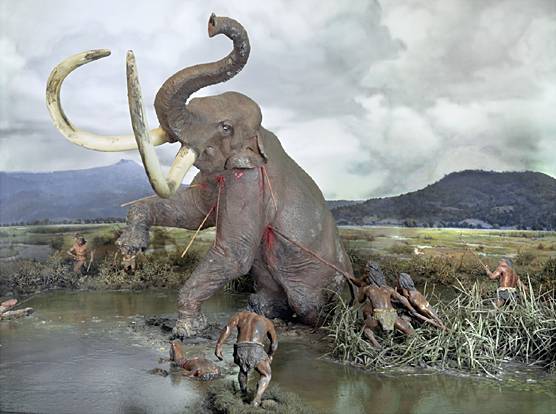
A/S/P do a great job of deconstructing many of the canonical stories about The Ascent of Man as male-centered fantasies. For instance, all the pictures of Stone Age hunters fighting mammoth or other large mammals (this latter from the classic Og, Son of Fire). These images show hunting as crucial, men-only, and risky -- but as A/S/P point out, this is based on neither good archaeology nor good anthropology. Modern hunter-gatherers don't habitually hunt large, fierce animals, it's not worth it the risk that someone will be injured or killed. The paleo-archeological evidence is much more compatible with "Mammoth Hunters" being Mammoth Scavengers, who only killed the animals when they were halfway dead already.

Disappointingly, A/S/P turn around and make up stories of their own. Chapter 6, "Leaving the African Cradle", ends with fictional accounts of the lives of various "mitochondrial mothers", which I found basically unreadable for their lack of a scientific basis.

This book really made me appreciate how many extremely inter-disciplinary paleoanthropology is, and how easy it is for specialists to run into trouble. A/S/P know a great deal about Late Stone Age technology, especially in materials other than stone: the perishable fiber, skin, and bone materials that undoubtably were most of the "stuff" in ancient people's lives. Since Elizabeth Wayland Barber's Women's Work: The First 20,000 Years : Women, Cloth, and Society in Early Times is one of my and their favorite books, I'm already on board with their program to actually look for evidence of perishable "stuff" and women's work. They're really good about bringing in an anthropologist's sense of the complexity of tool making, use, and ownership in traditional societies. People in the culture may tell the anthropologist that a particular task is "women's work" or a particular material is "for men", but in practice the two genders depend on each other continuously. Hypothetical example, though not unlike many North American Indian cultures:


Men's WorkWomen's Work
hunt deer 
skin deer 
remove hair & meat 
 soften (tan) hide
 cut hide into pieces
twist leather into sandalssew leather into shirts

So saying "men make sandals and women make shirts" is an oversimplification: it takes work by both genders to make each type of object, and no-one gets a complete outfit without cross-gender cooperation.

Though the book doesn't discuss this, I'll point out here that this, IMHO, is what human marriage is originally "for": the exchange of specialized labor between adults. Sex and children are side effects, the real purpose of marriage is to permit individuals to specialize in either "men's work" or "women's work" but be able to take advantage of both.

Back to the book. Although A/S/P are great at anthropology, they really don't know all that much biology. I feel as though they're really struggling with the fact that no organ comes "for free", that even eyes or intestines will fall away over evolutionary time if they're not useful. Not to mention that calling Alison Jolly "a primatologist who taught at Princeton" gave me a real WTF moment and shows they really aren't familiar with non-human primates and the people who study them (Jolly is the Jane Goodall of Madagascar, the first person to do real field observations of lemur behavior).

Bacause of their weakness in biology, A/S/P don't always know how much evidence they can use to eviscerate the Man-the-Hunter -Drove-Human-Evolution myth. For instance, they talk a lot about hunting animals versus gathering plant food (who did which, which was a more important source of nutrients, etc), but don't seem to realize that carnivorous animals aren't necessarily all that intelligent. In the human hunting:gathering equation, gathering -- using a wide variety of plants for food -- requires more brain-power than hunting. In the story of Christopher McCandless John Krakauer told in Into the Wild, for instance, what killed McCandless was what he didn't know about plant food; he had no particular trouble hunting more meat than he could eat.

It may also be their insecurity with the more biologically-based parts of the field that keep A/S/P from pushing the implications of their work back before the Upper Paleolithic. Evidence from human louse genes supports the idea that clothing and the strings that hold it together dates to about 70,000 years ago, though further louse research indicates that our ancestors lost their body hair much, much earlier, at the start of genus Homo if not before.

My dissatisfactions with the book in fact support A/S/P's thesis: that human evolution is such a complex and emotionally-loaded topic that we can't afford to exclude points of view. It's like trying to study a complicated structure you're living inside: you need to cross-correlate as many POVs as possible to get an idea of the big picture.

Labels: , , ,

Saturday, December 08, 2007

Book report: Baboon Metaphysics, by Cheney & Seyfarth

Book review at last! (or else InterLibrary Loan will come after me with *knives*):

Baboon Metaphysics: The Evolution of a Social Mind, by Dorothy L. Cheney & Robert M. Seyfarth.

Cheney/Seyfarth and their colleagues have done exemplary work developing behavioral experiments in the field, the Okavango Delta. They have done beautiful work using recorded calls & playback experiments, and they've resisted all temptation to interfere with the baboons' lives, even during lion attacks.

The book comes with my highest recommendation -- the Amazon Reader Reviews give a very good flavor for what's in it, overall. This is a list of things *I* learned, even if there's a lot more in it that may be new to you.

1. Baboons recognize kinship. I don't mean they just recognize their own kin - that's not surprising, has been documented in all kinds of critters. I mean they recognize *other creatures' kin relationships*. Most vivid story is about Ahla, a baboon that was kept as a goat-herder by a farmer. She made great efforts to unite mother goats with their proper lambs, to the point where it caused problems when the farmer tried the standard method of fostering one of a pair of twin lambs with another mother. Ahla had none of this: she knew which lambs went with which mothers, and that's how she was going to make it be.

2. Baboon societies are made up of matrilines, groups of female blood relatives. The matrilines have a dominance hierarchy which overrides individual dominance -- the matriline rises or falls *together*. Such alterations are rare, the female hierarchy tends to be stable for years running.

3. It's not clear that baboons think of kin relationships in terms of "mother", "child", but they definitely think that certain individuals "go together", and the "going together" is a lot like property relationships.

4. When a female fights with a female from another matriline, they more often make up by proxy than directly. That is, a relative from the other matriline makes reconciling gestures (e.g. grooming), they calm down, and that acts to reconcile the fighters -- even if they haven't made reconciling gestures to each other.

5. The male hierarchy is simple and volatile. Males have few long-term relationships, and C/S think this is one reason males have much shorter lifespans than females: strong social relationships are buffers against emotional stress, especially fear and grief.

6. In their study population, the leading cause of death for infants is infanticide by males. Adults mostly die from predation. The habitat is extremely rich and the population density high -- other baboon populations have much lower infanticide levels.

7. Apes all use tools, from time to time. Baboons never do. Apes do not live in complex groups, yet they are clearly more intelligent than baboons (although baboons are pretty durn smart). Tool intelligence and social intelligence overlap, they have something in common -- even though tools have no minds, and the key element of social intelligence is predicting what the other creature will do, reading her mind.

8. *Teaching* is uniquely human: human babies are better at imitating, but human adults also spend a lot of time deliberately helping youngsters learn, which does not occur with either apes or baboons.

9. Baboons, apes, dogs, and probably others can understand hundreds of linguistic categories even though they produce very few.

10. Most baffling example of baboon thinking: the Lord of the Flies incident. During a water crossing, *all* the group's juveniles were separated from the adults, staying on one island (in the swamp) while the adults swam to the next. For three days, the juveniles cried out in distress -- and the adults never answered. The group was reunited only when the juveniles finally got up the courage to swim over to where the adults were.

Labels: , , ,

Tuesday, November 13, 2007

Breasts and Evolution

Lightly edited from comments I left in a post by Amanda at Pandagon,
If only someone could make a nifty little program…. about whether men are really more "visual" than women, and some of the fallacies of "Evolutionary Psychology".


Puttin' on my Actual Evolutionary Biologist™ hat here.

Breasts are an example of how human anatomy & physiology have some unique and biologically bizarre features, features that contradict each other *and* contradict what evolutionary biology leads one to explect. Examples:

1) human males average larger than females -- as is expected if there is significant sexual selection on males (=females are picky, not all males reproduce)

2) human females have enlarged breasts, of a type found in no other mammal. This suggests that biologically unusual sexual selection on females is occurring. I don't think it can be to make nursing easier, Ailurophile, because my experience is that it *doesn't* -- it makes "latching on" a good deal harder than it is for droopy-chested chimps.

3) both human sexes (in most populations) have extremely exaggerated head hair, the longest hair of any mammal. This implies heavy, unbalanced sexual selection on at least one sex.

Look at it this way. You know how many other species of bird or mammals have males larger than females, but females more brightly-colored in *any* respect than males?[1]

*None*. Zip, zero. It does not compute. Far from being explicable by trivially easy "Evolutionary Psychology" reasoning (as practiced by sociologists, ferchrissakes), human reproductive biology is really problematic.

This is why I'm starting to think that self-domestication may be the missing link in human evolution. It's probable that for a long time (at least 100,000 years) humans have been attempting to control each other's reproduction, via arranged marriages and the like. No-one's done the math yet, so this is really just an educated guess on my part.

growth of the breast isn’t to encourage group survival, but is a result of sexual competition - females with bigger breasts had an advantage over their flatter sisters, suggesting (again) that males favoured them for whatever reason. Evo psych rears its ugly head again.
And again, this is why I talk about “evo-psycho”, because they don’t actually understand biology.

For female mammals to have elaborate, permanent display structures like breasts is *bizarre*, even unprecedented (the role & significance of the sexual swellings in female baboons is hotly debated). It’s particularly weird when you recall that a woman’s breasts swell while she’s nursing — *and thus infertile*.

Frankly, I don’t know why human females have “display breasts”. One thing I would definitely ask is, who are they displaying *to*? Potential mates, or potential in-laws? Or other females?


[1] In most warm-blooded animals males are larger and less camouflaged than females. There are some groups in which females are larger: baleen whales, birds of prey, and rabbits, for instance. In most of these, the males are still less camouflaged (e.g. Kestrels), so sexual selection is probably still acting on males, but ecological forces make them smaller.

There are a few birds in which females are larger and more brightly-colored than males (e.g. Phalaropes), and in these species females are polyandrous -- that is, sexual selection is for once acting more strongly on them than on the males.

There are *no* species in which males are larger and females are less camouflagued.

Labels: , , ,

Sunday, October 07, 2007

Evolutionary Psych & so on Book club?

I'm partway through reading The Invisible Sex: Uncovering the True Roles of Women in Prehistory, and I want as many of you as possible read it so we can discuss it in a book group of some time. This is indeed the droid I've been looking for: not "the evolution of woman", but how to look at the evolution of both human sexes in a single, evolving organism, and how they have developed into human genders. Ev-psycho free so far, just science.

The writers' expertise is in paleoarchaeology & anthropology, especially of perishable technology: wood, string, textiles. So far their tale is a little week in primatology & biology; I can't speak to their physical anthropology. I'd love to be able to talk about it when I'm done, though, so I'm giving you-all a heads up that Talk might happen in a couple weeks.

Labels: , , ,

Saturday, September 08, 2007

Reporting on Sexual Selection

A lot of people have linked to the CNN report about a study of human mate preferences with the headline "Men want hot women", which hilzoy called the Dumbest Headline Ever. What seems to have slipped by is that CNN's headline isn't just dumb, it's wrong -- that's not what the study found.

I haven't seen the full study (subscription required), but the press release helps me decode it a bit, as does the abstract. The article, "Different cognitive processes underlie human mate choices and mate preferences", is by Peter Todd et al., an international group mostly at the Max Planck Inst. in Berlin.[1]

As a biological rule, sexual selection is about female choice. Males do not, generally speaking, choose mates, they get chosen by females.[2] In the vast majority of animal species, males fight each other to be the one chosen by females. They compete for territories so females who are basically house-hunting will choose them along with the house. They are the ones who grow the bright colors or the elaborate antlers as conspicuous biological consumption, to show they have health and vigor to burn.[3]

There are a few species of birds where sexual selection is reversed and brightly-colored females compete for drab males, but this is never the case for mammals. When I was in grad school (in evolutionary biology) it is a byward that "milk is the limiting factor for mammal populations", which means that female mammals have even more at stake than female birds and are correspondingly choosier.

In other words, any time you see a popular discussion of human evolutionary biology, psychology, or sexual selection that does not focus on female choice, something fishy is going on. By "fishy" I mean:

a) the person doesn't actually understand evolutionary biology and is just making stuff up to fit their (his) prejudices and presuppositions

or

b) they are talking about something that is not based in biology, but *is* culture

or

c) they are talking about a way human biology differs from that of other animals, a way humans are distinctive and even abnormal

It's clear to me that Todd et al. are doing none of these things. This is really a methodological paper, to establish that speed dating can be used to study human mate choice. Speed dating is superficial and limited, but it also lets researchers study a lot of human interactions very quickly and without many ethical difficulties. This is a preliminary, does-this-fly study, that Todd et al. hope to use as the basis for studies with larger sample sizes.

One reason Todd et al. think speed dating is a reasonable thing to study is that they found men to be much less choosy than women. Again, this is exactly what an evolutionary biologist would predict: that female choice is crucial, while males will basically take whatever they can get. I think that if Todd et al. had found men being pickier than women at speed dating they would probably have thrown the results out as being culturally determined and therefore, from an evolutionary perspective, uninteresting.

This is what they mean by writing in the abstract that
Unlike the cognitive processes that Buston and Emlen inferred from self-reports, this pattern of results from actual mate choices is very much in line with the evolutionary predictions of parental investment theory.

Now, I think they're wrong. I don't think speed dating is a good predictor of human mate choice, whether "mate" means "person you live with" or "the other parent of your offspring". I think the anthropological evidence is that human mate choice (however defined) is *both* (a) subject to strong cultural influence, and (b) biologically distinctive.[4] I also see plenty of evidence that in most cultures sexual selection on females is as strong as sexual selection on males. This is a biologically unusual pattern, and thus should have biologically unusual causes and produce unusual results.

The mere fact that Todd et al. are using "speed dating" and "parental investment theory" in the same place should make you think twice -- or LOL, because becoming parents together is not really what the participants have in mind. More seriously, parental investment theory doesn't predict that all mating systems should be the same, or that females should *always* be doing the sexual selection -- it depends on the organism's ecology and reproductive biology.[5]

But, whether you agree with Todd or not, you should notice that CNN's headline says nothing at all about women's choices and how important they are: it's just What Men Want. Is this is common-or-garden variety sexism (in which men *must* be the active party), is it that the CNN editors subconsciously realize that women are choosy and thus need more information, is it part of a pervasive problem with science journalism echidne has discussed, is it just stupidity? I personally am splitting my vote between "sexism" and "stupidity", but you be the judge.

----------
[1] PNAS, the Proceedings of the National Academy of Sciences, has a complex and idiosyncratic submission policy which used to have a very large component of pure ego- and nepo-tism. That has been reduced, but it's still important to note who is listed as the "Editor" of a particular article. This one is credited to Gordian Orians, a evolutionary biologist (expert on vertebrate mating systems) for whom I have huge respect but who's not all that young anymore.

[2] This article is a good, non-controversial overview of sexual selection and mate choice.

[3] For instance, it's male peacocks who have the gorgeous tails, male deer who have antlers, male lions who have manes. Do I need more examples, or does everybody know this?

[4] Notably, in the vast majority of human cultures people other than the couple have input into human mate choice. This has no parallel in nature, which means it should have effects that a naturalist would not expect.

[5] For instance, marmosets and tamarins are small South American primates that are frequently polyandrous, where a single female mates with more than one male. Male marmosets do a great deal of baby-carrying and other child-care (=high paternal investment). Probably because of the extra help from the males and from older siblings, marmosets usually have twins and occasionally even triplets, while twinning is rare in other primates.

You can see from the abstract of this review article ("Ontogenetic variation in small-bodied New World primates: implications for patterns of reproduction and infant care") that parental investment theory doesn't predict a single social system for even this one group of creatures. It depends on what they eat, how fast the offspring grow before and after they're born, how large a group of adults can find food together, and even on twins being genetic blended in the womb. (that last article is *boggling* -- germ-line chimerism! in a primate! no wonder they're almost eusocial. I'm gobsmacked, scientifically speaking. I'll write more about this later.)

Labels: , , , , , ,

Saturday, July 14, 2007

How to Tell Biology from Bullshit: Polygyny and Female Choice

echidne of the snakes made a series of four posts about a recent article in Psychology Today, Ten Politically Incorrect Truths About Human Nature by Satoshi Kanazawa and Alan S. Miller.

Echidne has done a lot of work dissecting what is wrong with Kanazawa & Miller's article from the point of view of what you might call basic logic and knowledge of human society. I'm going to write about why their work (and a lot of so-call "Evolutionary Psychology" in general, which I'll call EvoPsy to distinguish it from actual scientific studies of evolution or psychology) is scientifically bogus.

I am a Real Evolutionary Biologist™ by training (*waves sheepskins*) and a science writer by sometimes trade. I will say as a blanket, dogmatic statement that you shouldn't write about evolution if you don't know biology. If you're going to claim to be an expert in the evolution of human behavior, you'd better show expertise in: evolution in general; the behavior of non-human primates; and anthropology, the study of a variety of human cultures. Kanazawa & Miller fail all these tests.

To start with their most obvious scientific failure: K&M state that humans are naturally polygynous (use a mating system where one male mates with many females). They also talk about a variety of qualities men supposedly look for in a mate: youth, hair color (!), beauty, etc.

These two things are opposites. It is true that biologists expect as a default that a mammal about which we know nothing else will be polygynous, because most mammals apparently are. We also expect that a bird will be monogamous, because most birds apparently are.

But -- we always expect that the males are the pretty ones. And the more polygynous the species, the prettier the males are likely to be.[1] It is the male peacock who has the beautiful, enormous tail; the male deer who has the big spreading antlers.

To use slightly more scientific terminology, sexual selection acts on males, because it is females who do the selecting. Females are the choosers, males are the choosees. If biologists talk about mate choice we are usually talking about female choice, because by the very definition of "male" (="the one with the small sex cell aka sperm") and "female" (="the one with the big sex cell aka egg") the female has more to lose by making a bad choice.

If real biologists see a species where the females show more sighs of sexual selection than males -- brighter colors, more complex display behavior, more elaborate secondary sex characteristics -- our gut reaction is, "wow, polyandry, how unusual." [2]

So, in nature polygyny means males choose their mates *less* and females are less beautiful. In nature, if a male gets to have many mates, he does not get to choose them, they are choosing him. In crude human terms, you can get a lot of action or you can be picky, you cannot have both. Females, who are expected to be more picky, can get mates more easily than males, and so they have the power of choice.

K&M are clearly not writing about "human nature" in the biological sense, they are writing a fantasy of power and sex. Any feminist can tell that they're doing this from their title -- "politically incorrect" is usually shorthand for "I have the power to not treat other people decently". K&M want the power to have sex with many women, but they also want the power to get women to look and act a certain way. This is not nature, this is a fantasy -- something in the human mind.

I'm not denying that the system K&M yearn for, polygyny with male choice, doesn't happen in many human societies. But it is patently unnatural, even anti-natural: it's not the human instance of a widespread natural pattern, it's something peculiar to human societies, something that makes it seem "natural" to behave in ways no other creature does. K&M don't seem interested in learning what that might be, and that makes them even worse scientists than they seemed already.

Because echidne asked so very nicely -- hardly any rains of amphibians or reptiles! really! -- I shall try to make this a series. Not on K&M, because they are too stupid and hurt my brain. But please make suggestions about topics you'd like to see a feminist Real Evolutionary Biologist address. Also, tell me where I need to put in links. Most of this stuff I know off the top of my head, so it's sometimes hard for me to recognize that you won't necessarily take my unsupported word for it.

[1] Should I put in a picture for illustration here?
[2] The link here is reasonably scientific, but out-of-date: it's now clear that there are various types of cooperative polyandry even in mammals. Examples: The small New-World monkeys marmosets and tamarins; the naked mole rat, the only fully eusocial mammal; the spotted hyena. Should I put links to accounts of these species?

Labels: , ,